
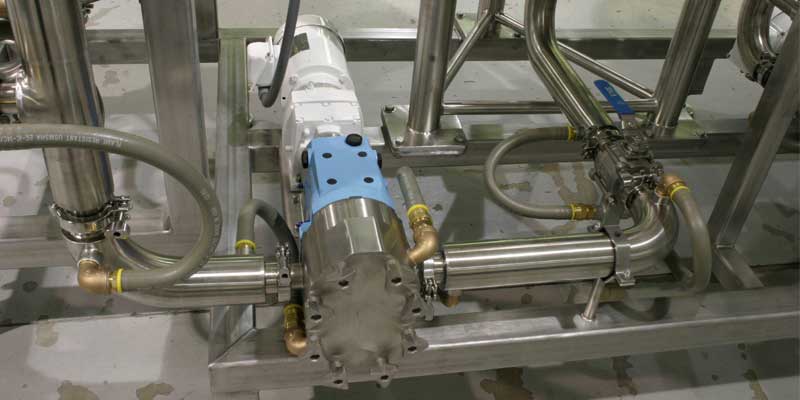

Selecting the right pump for a sanitary process is more than matching a pump to a required flow rate. The pump must also suit the product, pressure conditions, piping layout, cleaning method, hygiene requirements, and operating pattern of the entire system. A pump that performs well in one process may create excessive shear, cavitation, product damage, maintenance problems, or cleaning challenges in another.
For food, beverage, dairy, pharmaceutical, cosmetic, and personal-care applications, choosing appropriate sanitary pumps starts with understanding both the product and the process. Density, viscosity, temperature, solids content, sensitivity to shear, required flow rate, suction conditions, and discharge pressure should all be reviewed before a pump type or size is selected.
Understand the Product Before Selecting a Pump
The characteristics of the material being pumped are usually the most important part of the selection process. A thin beverage behaves very differently from cake batter, cheese sauce, cream, syrup, or a product containing suspended solids.
Viscosity deserves particular attention because it can change with temperature and processing conditions. A product that flows easily when warm may become much thicker as it cools. Some products are also shear-sensitive, meaning excessive mechanical force can alter their texture, consistency, or quality.
The size, shape, concentration, and abrasiveness of suspended particles should also be assessed. Large or delicate solids may require gentle handling and sufficient internal clearances, while abrasive particles can accelerate wear on seals and other wetted components.
Define the Pump’s Actual Job
The same product may require different pumps at different stages of production. A pump used to empty a tote or drum has different suction requirements from one transferring product between tanks. Filling, dosing, circulation, product recovery, clean-in-place return, and general transfer duties can also create different operating demands.
Before choosing equipment, define the required flow range rather than considering only a single design point. Calculate the expected discharge pressure and review suction conditions, including available net positive suction head. Poor inlet conditions can cause cavitation, unstable flow, noise, vibration, and premature component damage even when the pump appears correctly sized.
System configuration matters as well. Pipe diameter, total pipe length, fittings, valves, filters, heat exchangers, elevation changes, and the distance between source and destination all contribute to pressure loss. Selecting the pump without considering the full piping system can result in inefficient operation or unreliable performance.
Sanitary applications often use low-pressure systems, but heavy industrial processes need much more robust equipment. For example, high-pressure operations in the oil and gas sectors use specialized reciprocating technology. Standardized designs like API 674 Pumps are common in these environments because they handle low flow rates at high pressures. Knowing these pressure limits helps prevent equipment failure and keeps the plant running safely.
Make Hygienic Design a Core Requirement
In sanitary processing, hydraulic performance is only part of the decision. Product-contact surfaces, seals, connections, internal geometry, drainage, and accessibility should support effective cleaning and reduce areas where residue can collect.
The selected pump should be compatible with the facility’s cleaning approach, including clean-in-place or, where required, sterilize-in-place processes. Materials used for wetted parts and elastomers must also be appropriate for the product, process temperature, cleaning chemicals, and applicable sanitary requirements.
Modern facilities increasingly consider how quickly equipment can be inspected and maintained. A pump that is easier to clean, service, and reassemble correctly may deliver better lifecycle value than a lower-cost model that creates frequent downtime.
Common Types of Sanitary Pumps
Air Diaphragm Pumps
Air-operated double-diaphragm pumps are useful when portability, self-priming capability, or the ability to handle viscous and particulate-containing materials is important. Because there are no rotating seals in the conventional sense, they can be suitable for difficult transfer duties.
However, compressed-air consumption, pulsation, and the sanitary design of the specific model should be considered before using one in hygienic production. The pump’s wetted materials and diaphragm composition should also be compatible with both the product and cleaning chemicals.
Air Piston Pumps
Air piston pumps use reciprocating positive-displacement action to move low- to high-viscosity materials. They are commonly considered for products such as sauces, batters, creams, pastes, and other materials that may be difficult to move with a standard centrifugal pump.
They can be particularly useful when transferring product from drums, containers, or similar vessels. Product sensitivity, required flow consistency, cleaning access, and the presence of solids should guide final selection.
Centrifugal Pumps
Centrifugal pumps are widely used for low-viscosity liquids and high-flow transfer duties. Typical applications include water-like beverages, cleaning solutions, dairy liquids, and general process circulation.
They are often valued for relatively smooth flow, straightforward maintenance, and strong efficiency when operated close to the intended duty point. They are less suitable for very viscous products, and their performance can be affected by entrained air or inadequate suction conditions.
Variable-frequency drives are increasingly used with centrifugal pumps to match speed to changing process demand. Proper control can reduce unnecessary throttling, improve operating flexibility, and lower energy consumption.
Self-Priming Pumps
Self-priming sanitary pumps are designed for applications where the pump may encounter air or gas in the suction line. They are commonly useful for tank emptying, return duties, and some clean-in-place applications.
The term “self-priming” should not be treated as a guarantee that every pump can handle any suction condition. Lift height, fluid temperature, vapor pressure, piping configuration, and the manufacturer’s operating limits still need to be checked.
Peristaltic Pumps
Peristaltic pumps move fluid by repeatedly compressing flexible tubing or hose. Because the product remains inside the tube, the design can provide excellent containment and reduce the number of product-contact components.
These pumps are useful for controlled transfer, dosing, shear-sensitive fluids, and applications where contamination control is critical. Tube material compatibility, fatigue life, flow pulsation, and replacement intervals should be considered as part of the operating cost.
Positive Displacement Pumps
Positive displacement pumps are often selected when a process involves higher viscosity, lower flow, accurate volumetric movement, or pressure conditions that are unsuitable for a centrifugal pump.
Rotary lobe, circumferential piston, and twin-screw designs are examples used in hygienic processing. Depending on the design, these pumps can handle viscous or shear-sensitive products while maintaining relatively predictable flow as system pressure changes.
Twin-screw technology has become particularly attractive in some sanitary plants because certain designs can handle both viscous process fluids and higher-speed cleaning duties. This can simplify systems where one pump can serve both product transfer and CIP requirements, provided it is properly sized for both operating modes.
Progressive Cavity Pumps
Progressive cavity pumps use a helical rotor and stator arrangement to create sealed cavities that move progressively from the suction side to the discharge side. This produces a relatively smooth, low-pulsation flow.
They can be useful for viscous, shear-sensitive, or solids-containing products. However, stator compatibility, dry-running limitations, abrasive wear, cleaning requirements, and maintenance access need careful consideration in sanitary service.
Consider Efficiency, Controls, and Total Cost of Ownership
Pump selection should not stop at the purchase price. Energy consumption, seal life, spare parts, cleaning time, product loss, maintenance frequency, and unplanned downtime can have a much larger financial impact over the life of the equipment.
Where process demand varies, speed control can help keep a pump closer to its efficient operating range. Plants are also making greater use of condition monitoring, motor data, vibration information, pressure measurements, and flow data to identify developing problems before they lead to a shutdown.
Correct sizing remains essential. Oversized pumps can waste energy, increase throttling, raise shear, and cause unnecessary wear. Undersized pumps may fail to meet production requirements or operate too close to their limits. The goal is to select a pump that performs reliably across the realistic operating range, not simply one capable of meeting the maximum theoretical demand.
Check Cleaning and Maintenance Requirements
A sanitary pump should be evaluated as part of the complete hygiene programme rather than as an isolated piece of machinery. Consider whether all product-contact areas can be cleaned effectively and whether the pump is suitable for the required CIP flow, temperature, cleaning chemicals, and operating sequence.
Seal design also deserves attention. Mechanical seals, elastomers, and other wear components need to tolerate the process fluid as well as repeated cleaning cycles. Easy access to seals and commonly serviced components can reduce maintenance time and help production teams return equipment to service faster.
Plants handling multiple recipes or allergens should also consider how pump and piping design affects product changeovers. Reducing residual product and improving drainability can support more effective cleaning while reducing product and water waste.
Choosing a Pump for Changing Process Conditions
A common pump-selection mistake is sizing equipment around only one operating condition. Real production lines can experience changes in product viscosity, temperature, tank level, flow demand, and system pressure.
For example, a pump may need to handle a thicker product during production and then a low-viscosity cleaning solution during CIP. These operating points can place very different demands on the same equipment.
Reviewing the complete operating envelope before purchase helps determine whether one pump can efficiently perform all required duties or whether separate equipment would provide better reliability and lifecycle performance.
Final Pump Selection Checklist
Before purchasing a sanitary pump, confirm the product viscosity and temperature range, required flow and pressure, suction conditions, solids characteristics, cleaning method, material compatibility, hygiene requirements, available utilities, control strategy, and maintenance expectations.
It is also important to review the complete system curve and verify that the selected pump can operate safely during normal production, startup, shutdown, and cleaning.
The best pump is not necessarily the largest, fastest, or most expensive option. It is the pump whose hydraulic performance, hygienic design, product-handling characteristics, controls, and maintenance requirements fit the application as a complete system. Careful selection at the beginning can improve product quality, reduce energy use, limit downtime, and extend equipment life.
Comments are closed.